


Draw House Plans — Tutorial
Module 5: Indoor Spaces Bubble Diagrams
Before you begin to actually draw your house plans, it is a good idea to create simple architectural bubble diagrams for your floor plans. This will allow you to play around with the locations of rooms and how they interact with one another.
This is Module 5 of the Design Your Own House online tutorial. If you are just starting out with your house design, you may want to go to our tutorial site map to go through the tutorial in order, or to jump around it as it suits you.
Bubble Diagrams
Now it's time to create a different bubble diagram than we did in the site analysis module—this time indicating the functional spaces within your home. Make photocopies of your house plot plan but choose a lighter setting on the photocopier so that the plot plan information is still visible but not as distracting.
Another option is to lay a sheet of tracing paper or a clear piece of mylar over top of the site plan. Now consider all your notes on your space requirements page and consider some of the options for house location. Choose one of your potential house locations as indicated on your site map.

Start with drawing a bubble for where your main entrance could be. Where you will enter your own home, most of the time. Mark small bubbles at any other places where you feel you will need a door or entrance. If you will have a yard, vegetable garden, driveway, or foot path from another direction, consider how you will enter the home from those various places.
At this point you are just drawing small bubbles so don't get too concerned if it looks like you will have several entrances. Later when you have firmed up your ideas and are drawing the actual floor plans, you can figure out how these entrances can be combined to result in fewer doors. But initially mark all these bubbles so you can see where the ideal places are.
You probably have an idea for the types of house styles you like in terms of what they look like from the outside. It's important to have a rough idea of this at this point. (Later in the tutorial, we'll discuss exterior house designs.) Will the house have one floor or more? This will affect whether your floor plan bubbles are all in one plane or whether some will be on different levels.
Example Architectural Bubble Diagrams for a Two Story House
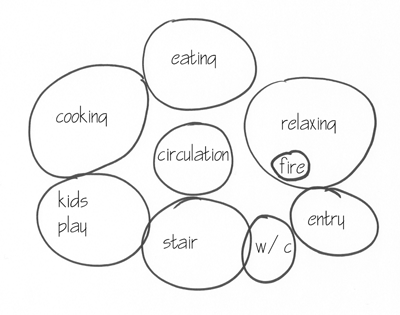
Main Floor

Upper Floor
Draw Circulation in Diagrams
Consider how the traffic will flow from space to space. When entering the home where will you usually go first? Where will your friends or guests go? Consider what you want to see when you first enter your home. Mark all circulation spaces (such as hallways or even just traffic areas) as bubbles on your diagrams.
Organization of and Relation Between Spaces
Consider what kind of space you want where you first enter your home. A formal space with a closet or a very casual space with lots of hooks and shelves to place your things? Or something in between? Consider whether you prefer a separate formal entrance or whether a separate entrance is necessary.
What do you want to be looking out at from various spaces? Make sure that you are considering your site as you locate your bubbles. Pick any peaceful views for spaces where you will want to be relaxing and enjoying the view. Put spaces that do not require a view in places where the view is not as prominent. Consider where to place spaces that require privacy from some outdoor spaces but also natural light. Also consider local noise sources and breezes.
Begin to draw house plans bubbles for each space or room keeping in mind the connection between the rooms or spaces. Think about where you will prepare food and where you will eat it. Do you want your living area and/or eating area open to your kitchen or completely separate?
Stairs
If there will be a basement or more than one story to your house, draw a bubble for a potential stair location. (We will discuss the amount of space required and the types of stair shapes in a later module.) At this point, simply draw a room sized bubble for the stair. Make sure that you make this stair bubble on all floors of the house in the same location. Usually, the stairs for all levels are stacked in one space of the home resulting in essentially a two (or more) story open space in the home. This space must be marked on all levels since it is unavailable for rooms or circulation spaces.
The Fire
If you will have a fireplace, woodstove or a zero-clearance fireplace, make a bubble for it as well on your diagrams. Make a reasonable sized bubble for them. Woodstoves, although they do not necessarily need walls behind or beside them, require enough space around them to pass safely.
Keep in mind where your chimney will exit the roof. The chimney or stove pipe will need to be cleaned on a regular basis and ease of access is important. In our area, the chimney or stove pipe top must be about two feet above the highest roof surface or structure within about ten feet of it. Our roof is very steep and the slope of the roof surface ten feet away is roughly 12 feet higher. If our chimney was built anywhere low on the roof slope, it would need to be 12 feet plus 2 feet, or 14 feet high.
This would create a crazy chimney requiring lateral support. This design would probably look rather odd and be difficult to clean. We located our fireplace so that it would exit the roof very close to the peak of the roof. The chimney only needed to be a few feet high and one can straddle the roof peak to drop a chimney brush down it.
At this point, you are merely creating loose bubble diagrams but you do need to be thinking about how the outside of the house may look and the type of roof style you may want. These ideas will affect things like fireplace location. Exterior house design and roof types will be covered before you firm up the walls of your bubble diagrams.
Use Case Scenarios
In this part of your design process, it is important to consider what I call use case scenarios. A use case scenario is simply an ordered list of steps that you go through for a given task. These use case scenarios can then be used to check if your bubble diagrams work well for your family. Let's take the example of food. Here are some example use case scenarios for food and family supper.
Food
- Groceries come into home.
- Bags are placed on counter (or floor).
- Items go into fridge, pantry or freezer as required.
Family Supper
- Food is taken from fridge or pantry and placed on counter
- Produce is washed.
- Cutting and chopping as required.
- Scraps go into compost.
- Sauces mixed.
- Food is cooked on stove top or oven.
- Plates are put on counter next to stove.
- Food is served onto plates.
- Table is set with cutlery.
- Plates are brought to dining table.
- Plates are cleared to counter.
- Dishes are scraped into compost and garbage.
- Dishes go into dishwasher or to sink for washing.
Write your own use case scenarios and then with your bubble diagrams in front of you, go through each use case scenario and walk through each step. Does it work well? Is it easy to get the groceries into the kitchen? Is there a convenient place to set them as you put them away or will you need to walk back and forth too much?
Create a scenario for every typically recurring aspect of your family life. Scenarios could include meals, bedtime routines, laundry, homework for children, music practice, entertaining, sports, hobbies, overnight guests, recycling, garbage and compost.
Don't forget to include the full cycle of a scenario. That is, recycling doesn't just end with tossing something in a bin or bag in the home. This bin or bag needs to get to wherever the recycling is collected and back into your home again. Likewise with compost. It needs to get out to the composter in the yard (where will that be best placed so you will actually use it in all weather conditions?), the inside compost container needs to be rinsed or washed and returned to wherever it lives in the home.
Walk through each of your scenarios with your bubble diagrams in hand. Do they work? Make notes and make adjustments to your home drawings to reflect how you really live.
Continue to Consider Previous Worksheets and Drawings
You should be developing a diagram of interlinked spaces or rooms. Keep going back to your needs analysis page and asking if spaces will meet their needs and keep going back to your house plot plan to check if the rooms or spaces will be in the right places on your land.
Next Module—Exterior House Designs
Before moving on to firming up your bubble diagrams to actual walls on floor plans, let's first look at:
Exterior House Designs: Module 6 of the Design Your Own House tutorial.
