


Residential Structural Design
Part 1—Vertical Structural Forces
Before moving on to designing floor plans, we'll need to learn some residential structural design basics. The indoor space bubble diagrams you have already created will eventually turn into floor plans but first you need to consider what structural elements will need to be created within those spaces in order to support the roof, floors and the forces acting on and within the house.
This online tutorial is best followed in order. If you are just starting out with your house design, see our tutorial site map to go through the tutorial in order, or to navigate it as it suits you.
Residential Structural Framing Primer
First let's talk about the types of loads on a house and how those loads can be supported.
The picture below shows vertical forces acting on a house roof and those forces being transferred down the roof and then to the ground by the structural walls.
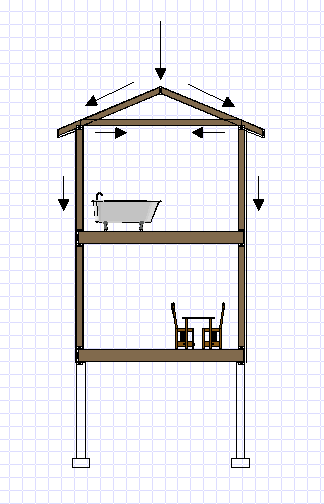
The vertical forces acting on a residential structure include both live loads and dead loads. Live loads are considered anything that can move or shift, such as people, furniture and snow loading. Dead loads are forces that do not move. Dead loads include the weight of the roof, floors and built-in furniture.
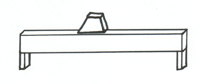
Let's back up a bit and discuss how loads are transferred along a simple wood beam or joist. A wood member will always be strongest when oriented so that its widest dimension runs parallel to the majority of its loading forces. Look at the images below.
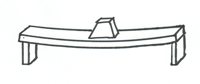
In the first image, the wood beam is loaded so that the thinnest dimension is parallel to the loading force. Note that this beam deflects noticeably.
In the second image the wood beam is loaded so that the widest dimension is parallel to the loading force. Note that this beam does not deflect as much.
Let's go back to the house example to see how the vertical forces are transferred through the structure to the ground. In the most simple case, a house could consist of four walls and a flat roof. The image below shows a cross-section of such a house. (A cross-section view shows what you would see if you took a vertical slice of the house as if you had sliced it like a loaf of bread.) Here we are looking at two of the outside walls and the flat roof.
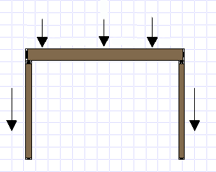
In this image, vertical forces applied to the flat roof are applied to the flat roof which are in turn supported by the vertical support (load bearing) walls at which they can travel downwards. At these walls the forces travel down to the ground.
A house is supported entirely by vertical and horizontal systems (and sloped systems such as sloped roofs). Loading forces are supported by either columns (posts) or load bearing walls. Floors take loading forces (such as the weight of the building, people and furniture) and transfer them to these columns or walls. Likewise the forces on the roof are transferred to columns and/or walls.

Now let's take a look at the different ways to support a house like the one shown in the example above.
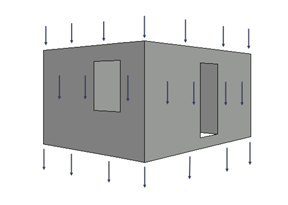
As mentioned earlier, the house can be supported by load bearing walls, columns (posts) and beams or by light structural elements (such a wood or steel) which is really a combination of the two other support mechanisms. Let's illustrate this with pictures. In the first image below, the vertical forces of the house are supported entirely by load-bearing structural walls. In the type of residential structural design below, we have used concrete walls. There are openings in the concrete for doorways and windows but these openings have been calculated so that the walls will be strong enough to support the floor above and the roof.
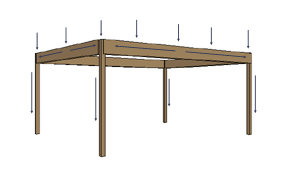
In our next example, the house is supported by columns and beams. There are many ways for these columns and beams to attach or join to one another. For now, we are simply looking at how the loading forces are transferred. The picture below shows how the loading forces are transferred in a house supported by posts and beams. Keep in mind these posts and beams can be made out of many materials including wood, concrete and steel.
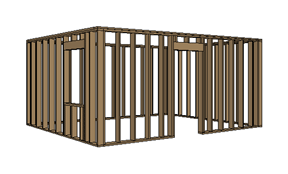
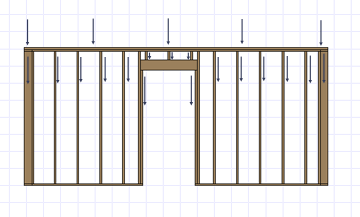
Finally, let's consider structural framing with light structural elements. By this we could mean a traditionally wood-framed house or a light steel framed house. This style of residential structural design can be considered a combination of both load bearing walls and post and beam construction since, as a whole, the framed exterior wall is a load bearing wall but all the elements within in are acting as posts and beams. Look at the picture below.
Let's take a look at just a single wall of this style of residential framing and look at the force transfer.
Designing with Structure in Mind
So you know now that your house can be supported in a few different ways—with structural walls, posts and beams or light structural elements such as wood or steel framing. At this point, it is important for you to consider the type of house you are planning and the type of construction most suited to that style.
The most common house construction method in North America is wood framing. Many types of homes can be built in this way. If your home will be a timber frame, adobe or straw bale home, you will most likely support it with posts and beams.
A home can also be made entirely of structural walls such as poured concrete, concrete block or concrete in Insulated Concrete Forms (ICFs).
Next Tutorial Section—Designing with Wood Joist Span Tables
The next step in designing your own house is to learn how to size the various structural elements within your home design. At this point, we'll focus on traditional wood framing for an example house in the next part of Residential Structural Design:
Part 2: Designing with Wood Joist Span Tables.
For a thorough discussion of building structural design, see the U.S. Department of Housing and Urban Development's Residential Structural Design Guide: 2017 Edition.
